
Monroe County Court Records After a Jail Arrest
An arrest in Monroe County begins with the sheriff or a local police department and a booking at the jail. The court record begins later, when the Monroe County State's Attorney reviews the case and files charges. That office prosecutes violations of state law and county ordinances. The charges the prosecutor files can differ from the charges listed at booking, because evidence and review can change, reduce, or drop them.
It helps to keep two record sets apart. The booking side answers why a person was taken in, and that detail sits with the jail, covered on the Monroe County jail inmate records page, with booking photos on the jail mugshots page. The court record answers what the prosecutor filed and what the court did with it. After an arrest, the court file is the authority on the charges, the docket, and the result.
How to Find Monroe County Court Records After an Arrest
Monroe County court cases are searched online through Judici, the case portal that the county and the 24th Judicial Circuit link from their official pages. The State's Attorney also directs people with court-date questions to Judici or the county court case management system. You can search by a defendant's name or by case number, and a daily docket shows upcoming court dates.
- Open the Judici Monroe County court page.
- Search by the defendant's name, or by case number if a citation or notice gives you one.
- Open the case and read the charge list, the filing dates, and the docket entries.
- Check each charge for its code, level, and current status.
The Judici welcome page shows the Cases and Docket tabs you will use most.
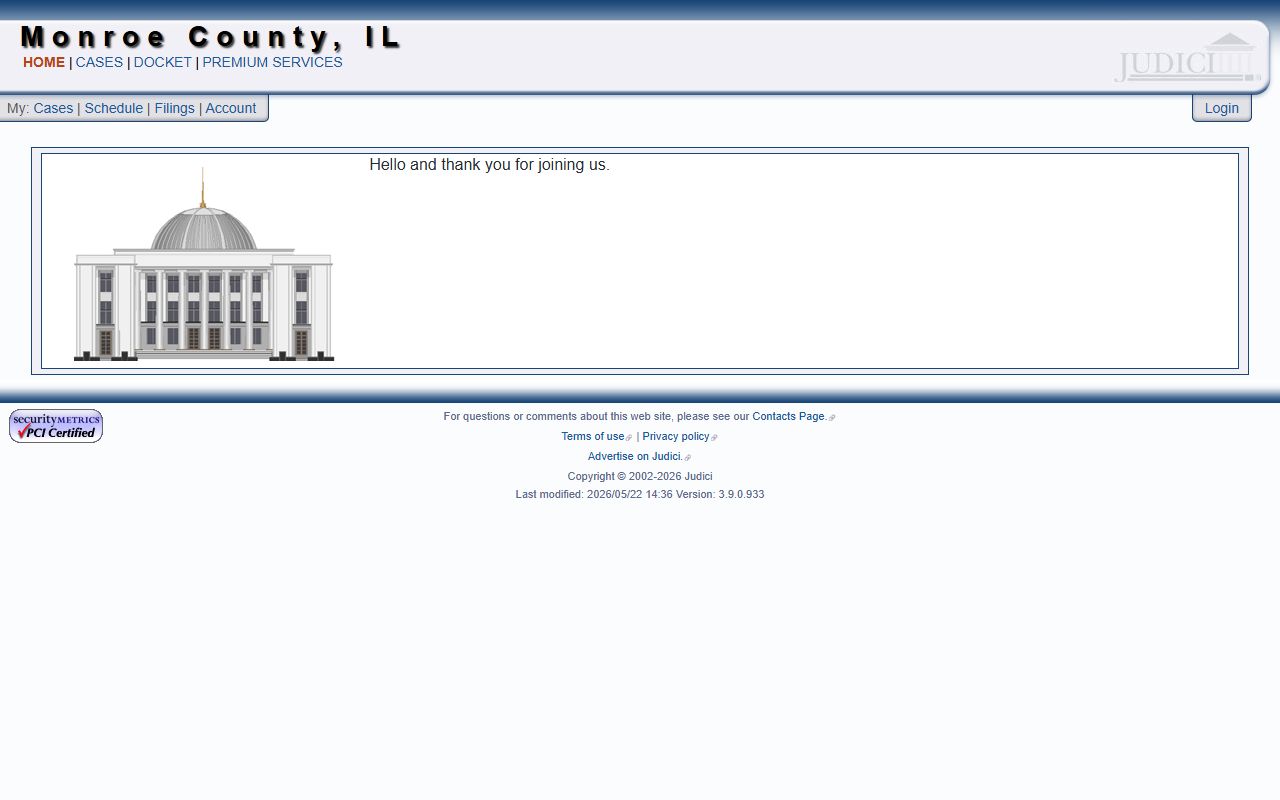
The portal may show a CAPTCHA on the case and docket pages, which is normal for public court search. If a name returns nothing, try a different spelling or check again later, since a filing can lag the arrest by days. For older files or case-number help, the Circuit Clerk can assist in person.
| Search Path | Use |
|---|---|
| Defendant name | Find criminal or traffic cases when you have no case number. |
| Case number | Best when a citation, complaint, or court notice provides it. |
| Daily docket | Find same-day or upcoming court appearances. |
| Login / My Cases | Optional account features, not needed for basic public search. |
How Charges Get Filed After a Monroe County Arrest
Walk the path forward from the arrest. The jail books the person, then the charge record begins when the prosecutor files a charging document. Three main types start a criminal case in Illinois, and which one is used depends on the level of the offense and how the case is brought.
| Complaint | Information | Indictment | |
|---|---|---|---|
| Filed By | Officer or prosecutor | Prosecutor | Grand jury |
| Common For | Misdemeanors | Many felonies | Serious felonies |
| Starts | The case | The case | The case |
Whichever document is used, it is the moment the court record opens. Until then, a person may be booked on suspicion or a warrant without a filed case showing in the court search.
Who Files the Charges: Monroe County State's Attorney
The Monroe County State's Attorney, Ryan G. Webb, leads the office that files and handles criminal charges after an arrest. The office is at 100 S. Main St. in Waterloo and is open weekdays from 8:00 a.m. to 4:30 p.m. The office prosecutes state and county offenses and also advises county government. It does not act as anyone's defense lawyer and is limited in what it can discuss with the public.
The office routes work by case type, which is useful when you know a case prefix. You can reach it through the Monroe County State's Attorney page shown here.
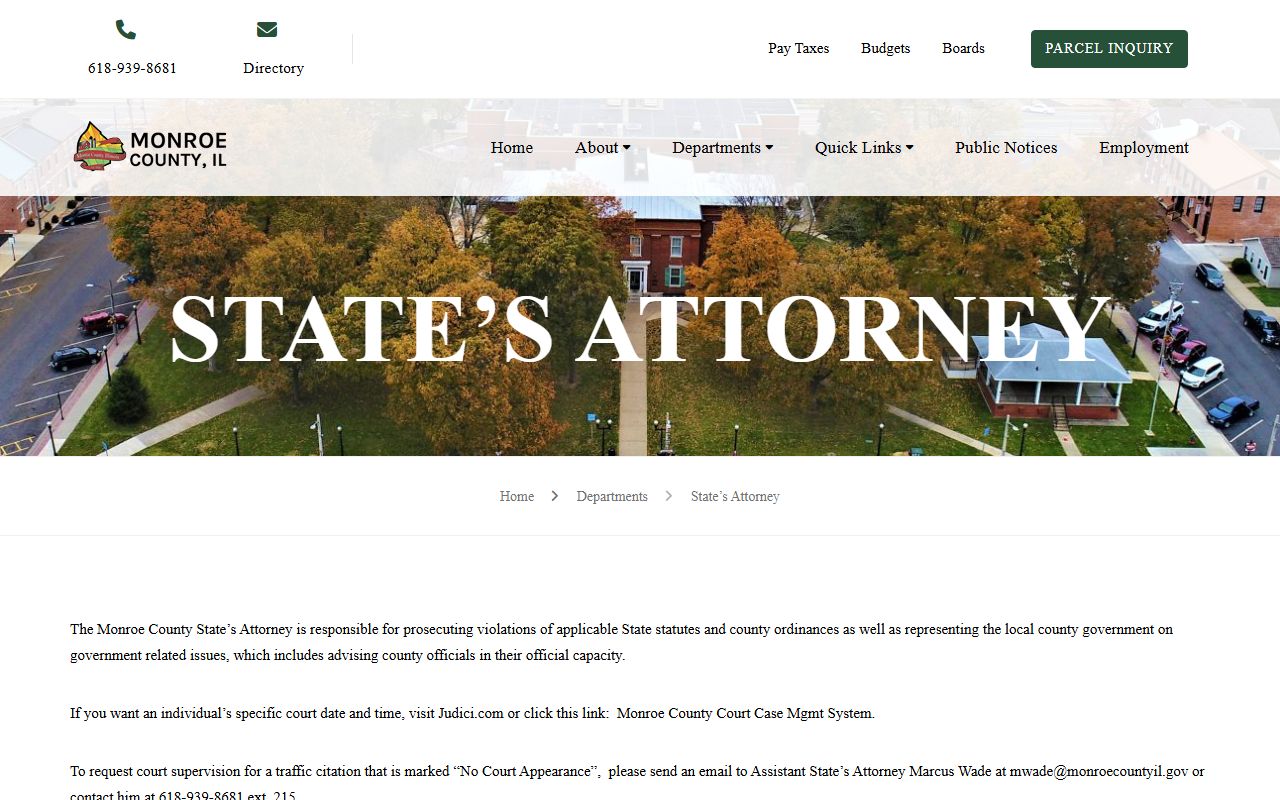
Felony, misdemeanor, and domestic-battery matters route to the State's Attorney; DUI, traffic, ordinance, and conservation cases route to an assistant; juvenile cases and expungements have their own assigned staff. Questions about warrants, scheduling, and discovery go to the office's legal assistants by phone at 618-939-8681 ext. 215.
Reading Charge Status in Monroe County Court Records
Charges change as a case moves. A prosecutor can amend, reduce, add, or drop them, and the booking charges on the jail side can differ from what the court file finally shows. The common status terms below are worth knowing before you read a docket.
| Status | What It Means |
|---|---|
| Pending | The charge is filed and not yet resolved. |
| Amended / Reduced | The charge language or statute was changed, often to a lesser offense. |
| Dismissed | The charge was dropped and is no longer being pursued. |
| Nolle Prosequi | A formal notice that the prosecutor will not pursue the charge. |
| Supervision | An Illinois disposition that can avoid a conviction if the terms are completed. |
Note: a charge is an accusation, not a finding of guilt, and a dismissed or reduced charge can read very differently from the original booking entry.
Release and Detention After a Monroe County Arrest
Illinois changed how release works. The Pretrial Fairness Act took effect statewide on September 18, 2023 and ended money bail for pretrial release. Older records and everyday speech may still say bond, but current custody turns on court-ordered conditions and detention decisions rather than paying a set amount to get out. A judge may release a person with conditions, order detention where the law allows, or address a warrant or hold.
| Term | How It Works in Illinois |
|---|---|
| Cash bail / money bond | Ended for pretrial release as of September 18, 2023. |
| Surety / commercial bondsman | Not the normal release path in Illinois after the reform. |
| Recognizance / conditions | Release on a promise and court-set conditions, not a deposit. |
| Detention order | A court order holding an eligible defendant before trial. |
| Warrant / hold / detainer | A separate reason a person can stay in custody despite a local case event. |
Because of holds, a person can win release on the Monroe County case and still remain in custody on a warrant, another county's case, or a state or federal hold.
From Arrest to First Appearance in Monroe County
The court record starts to take shape at the first appearance, the early hearing where a judge addresses charges and release conditions. Pretrial services are part of this stage. The 24th Judicial Circuit lists a Monroe County pretrial officer, Amanda Jaycox, whose work supports the release and detention decision after an arrest. Probation staff also appear in the circuit's contacts, which matters for anyone arrested on a probation violation or later placed on supervision.
Reading the docket in order helps make sense of a case. The filing opens the record, the first appearance sets early conditions, and later entries track hearings, motions, and the outcome. If the online file is hard to follow, the Circuit Clerk can explain the entries and pull older records in person, since the court file is the lasting account of what happened after the arrest.
Monroe County Warrants That Lead to an Arrest
Monroe County does not publish a public online warrant search on the sheriff or county sites. An outstanding warrant or a body attachment can lead to a booking at the jail. The sheriff's civil-process division lists arrest orders and writs of bodily attachment among the court documents it serves, which is a court-ordered route into custody. A restraining order is another path. The sheriff's pages note that a judge issues such orders and that a violation can lead to an immediate arrest.
To check for a warrant, the practical channels are the court file on Judici, a call to the sheriff for custody and warrant routing, and the State's Attorney's office for case-specific warrant, scheduling, and discovery questions. A wanted matter should be resolved through the court, an attorney, or law enforcement rather than a commercial database, and the site does not publish ways to avoid a warrant.
Charges vs. Convictions
Being arrested and charged is not the same as being convicted. A charge is an accusation that the case must still prove. A conviction is a verdict or a plea. Both can appear in a public court record, but they carry very different weight.
| Charge | Conviction | |
|---|---|---|
| Stage | Accusation | Verdict or plea |
| Burden of Proof | Probable cause | Beyond a reasonable doubt |
| Public Record | Yes | Yes |
Sealed vs. Expunged Arrest Records
After a dismissal or an eligible outcome, a person may be able to clear an arrest or court record through sealing or expungement. The two are not the same. Sealing hides a record from most public view, while expungement treats it as though it never existed. In Monroe County, the State's Attorney's office assigns an assistant to handle expungement questions, and a person may also need court forms or their own attorney.
| Sealed | Expunged | |
|---|---|---|
| Visibility | Hidden from public view | Destroyed or treated as never existed |
| Law Enforcement | Limited access | Very limited access |
| Eligibility | Depends on the charge and outcome under Illinois law | Often after a dismissal or an eligible disposition |
Circuit Clerk and In-Person Court Records
The Monroe County Circuit Clerk, Lisa Fallon, keeps the court records and can help with older files, case numbers, and copies. The office is at 100 S. Main St., Room 115 in Waterloo, reachable at 618-939-8681 ext. 224, and open weekdays from 8:00 a.m. to 4:30 p.m. The county and the 24th Judicial Circuit both link the clerk and the online case search.
The Illinois Courts directory lists the Monroe County Courthouse at 100 S. Main St. with an online case-search link and free parking around the building. You can confirm the courthouse details on the Illinois Courts Monroe County Courthouse page shown here.
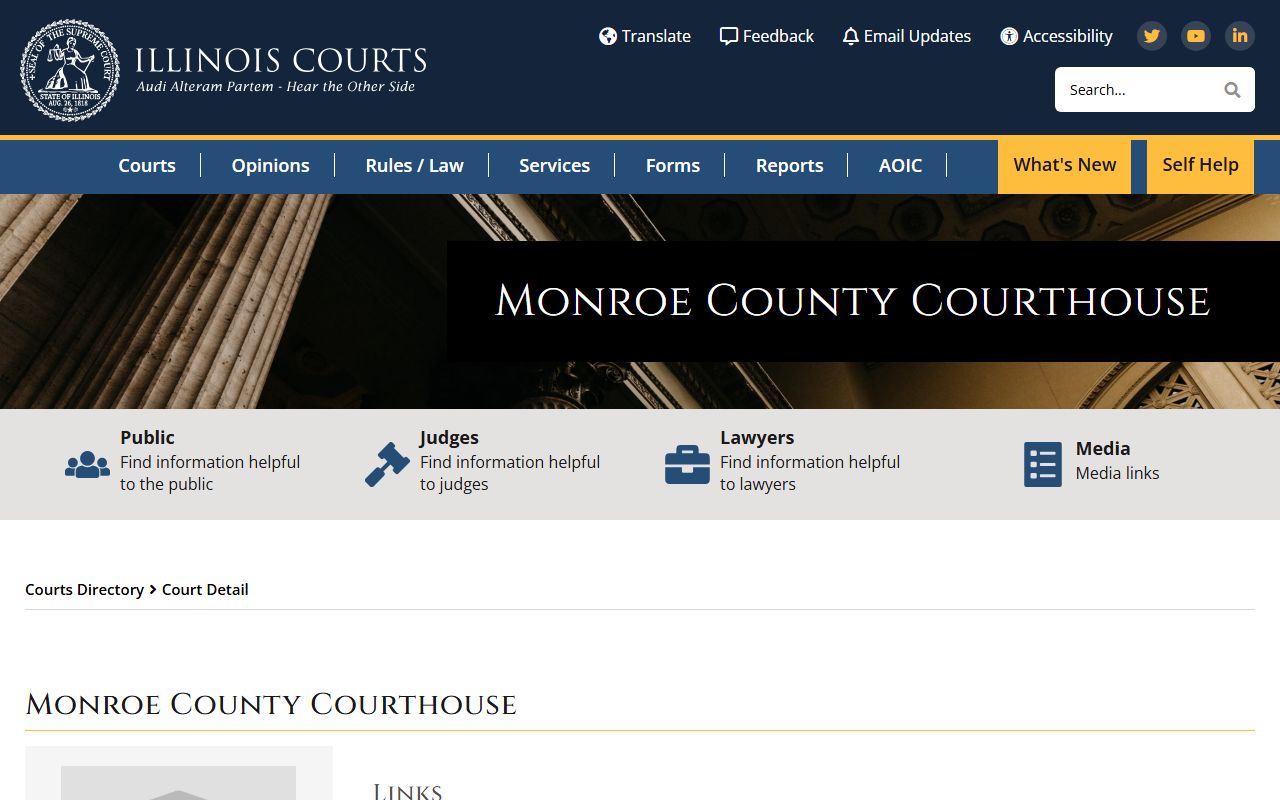
The clerk's office also offers a county court app and several payment channels, though after the bail reform paying a court fine or fee is not the same as posting bail.
Restricted Court Records After an Arrest in Monroe County
Not every record shows up in a public court search. Juvenile cases, sealed or expunged matters, certain dismissed charges, mental-health cases, and active investigations may be withheld or redacted. A blank result does not prove that no case exists, so a person may need to ask the Circuit Clerk for help or file a records request with the right office.
Important: This is a private reference site and not a consumer reporting agency under the FCRA, so nothing here may be used for hiring, housing, credit, or other FCRA-covered screening.